About ABB Soft Starters
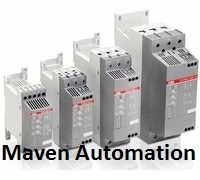
ABB Soft Starters
PSR The compact range
The PSR soft starter is the most compact of all the soft starter ranges, thereby making it possible to design compact starting equipments. The system concept with Manual Motor Starters and the PSR provides a far more compact starting solution than for instance a star delta starter. Built in by pass reduces the energy loss and makes the connection easier and with only three potentiometers, the set up could be any easier. Still, the optimized ramping characteristics will ensure a very smooth start and stop for all applications.
Work:
Use an ABB softstarter equipped with current limit to keep control of the starting current.
Our softstarters will reduce the mechanical stress during start, thus avoiding slipping belts.
A softstarter with underload protection will detect broken belts, making the operator immediately aware of the problem.
Flexible Installation OptionsABB Soft Starters are engineered for versatility in installation, allowing mounting on DIN rails or panels as required. Their compact dimensions of 320 x 180 x 210 mm and durable metal enclosure ensure they fit easily into control panels or machinery spaces, delivering robust control in pumps, compressors, conveyors, and HVAC systems.
Advanced Motor Protection and DiagnosticsEquipped with comprehensive protection-including overload, short circuit, and phase loss-these soft starters safeguard equipment and ensure operational reliability. Integrated fault diagnostics, LED/LCD displays, and programmable parameters support predictive maintenance and swift troubleshooting, minimizing downtime.
User-Friendly Operation and ConfigurationConfiguration is both convenient and versatile, with options to program settings via the front panel or PC. The microprocessor-based control system, along with auxiliary contacts and LED indicators, enhances usability and real-time monitoring-making management and adjustments straightforward for operators.
FAQ's of ABB Soft Starters:
Q: How can ABB Soft Starters be configured for different applications?
A: ABB Soft Starters can be easily configured via the front panel or a PC, allowing customization for specific applications such as pumps, compressors, conveyors, and HVAC systems. The user can program start and stop parameters, protection settings, and utilize built-in diagnostics for optimal operation.
Q: What installation methods are available for ABB Soft Starters?
A: These soft starters are designed for both DIN rail and panel mounting. Their robust design and compact dimensions allow for flexible installation in new or existing control panels, making them suitable for varied industrial environments.
Q: When should the cooling fan option be considered for ABB Soft Starters?
A: The availability of a cooling fan depends on the model and operating conditions. For applications with higher current requirements or elevated ambient temperatures, soft starters with built-in fans are recommended to maintain optimal performance.
Q: Where can ABB Soft Starters operate effectively without performance loss?
A: ABB Soft Starters operate efficiently at altitudes up to 2000 meters without derating and withstand harsh environmental conditions, including humidity up to 95% (non-condensing) and a broad temperature range. They are ideal for diverse industrial sites across India and globally.
Q: What is the process for wiring and connecting ABB Soft Starters?
A: Connections are made via terminal blocks for power and control circuits. The control system supports multiple voltage inputs (24V DC / 110-240V AC), with auxiliary contacts (2 NO + 2 NC) simplifying integration into broader automation systems and ensuring flexibility in wiring and operation.
Q: How do ABB Soft Starters enhance the lifespan of connected motors?
A: By delivering soft start and stop functions, as well as comprehensive protection against overload, short circuit, and phase loss, ABB Soft Starters significantly reduce electrical and mechanical stress on motors. This helps extend both mechanical (over 1 million operations) and electrical (over 500,000 operations) life cycles.







 Send Inquiry


 Send Inquiry


