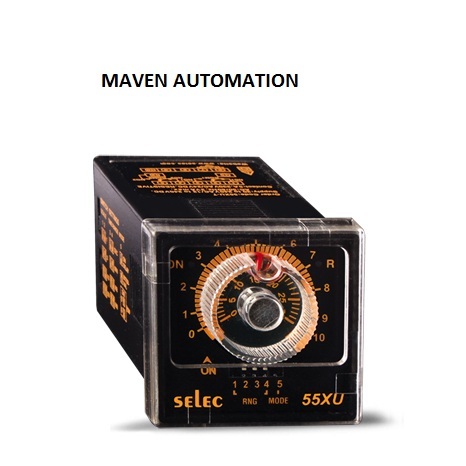
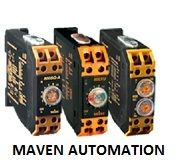
About SELEC Analog Timers- Plug/Panel Mount
On Delay / Interval timer, 12 Time Ranges [55XU]55XU-P8
- 55XU-P8-CU
- 55XU-T8
- 55XU-T8-CU
Cyclic Timer, 6 Time Ranges [55XC]
- 55XC-P8
- 55XC-P8-CU
- 55XC-T8
- 55XC-T8-CU
On Delay / Interval Timer, 8 Time Ranges [55ES]
- 55ES-P8-230
- 55ES-P8-230-CU
- 55ES-T-230
- 55ES-T-230-CU
- 55ES-P8-110
- 55ES-P8-110-CU
- 55ES-T-110
- 55ES-T-110-CU
Versatile Timing OperationsSELEC Analog Timers cater to different timing requirements, offering a comprehensive range of operating modes such as ON Delay, OFF Delay, Interval, and Cyclic. This adaptability allows users to select the mode most suited for their applications, making these timers invaluable for industrial automation and repetitive process control tasks.
Easy Installation and Flexible MountingDesigned with both plug-in bases and panel mount options (retaining clips included), SELEC timers simplify the installation process and offer compatibility with standard panel cutouts (45x45mm or 48x48mm). These features help users and installers quickly integrate timers into control panels or replace existing devices with minimal disruption.
Precise and Reliable PerformanceWith a setting accuracy of 1% and repeat accuracy of 0.2%, these timers ensure consistent time delays. The <200 ms reset time and LED indicators for power and relay status enhance operational efficiency and reliability, making SELEC Analog Timers suitable for environments where timing precision is critical.
FAQ's of SELEC Analog Timers- Plug/Panel Mount:
Q: How do I select the right SELEC Analog Timer for my specific application?
A: First, determine the required time range and mode of operation (ON Delay, OFF Delay, Interval, or Cyclic). Next, identify the suitable power supply voltage and contact configuration (SPDT or DPDT) based on your control circuit. Finally, choose the appropriate mounting type-panel or plug-in-and confirm compatibility with your panel cutout dimensions.
Q: What are the main benefits of using SELEC Analog Timers in industrial environments?
A: SELEC Analog Timers provide accurate timing control, high repeatability, and versatile operation modes. Their robust construction, LED indicators, and quick reset capability ensure reliable performance in demanding environments, reducing downtime and supporting automation and process efficiency.
Q: Where are these timers typically installed or used?
A: SELEC Analog Timers are commonly installed in control panels within manufacturing plants, machinery, process automation systems, and other industrial settings throughout India. They are suited for any application requiring time delay relays, such as conveyor belts, motor control, and automated switching.
Q: When is it necessary to use a timer with different modes of operation?
A: Multiple operating modes are crucial when your process requires specific timing actions-such as delayed starting (ON Delay), timed shutdown (OFF Delay), repetitive cycling (Cyclic), or fixed intervals (Interval mode). Selecting the appropriate mode ensures optimal control for your application.
Q: What is the process for installing a SELEC Analog Timer?
A: First, select the right mounting option (plug-in or panel mount). For panel mount, cut the appropriate size (45x45mm or 48x48mm), insert the timer, and secure with retaining clips. For plug-in models, fit the timer into the base. Connect the wiring according to the provided diagram, ensuring correct voltage and contact assignments, then power on.
Q: How can I verify the timer's status in operation?
A: SELEC Analog Timers feature Power ON and Relay Status LEDs on the front panel. These indicators allow users to quickly verify at a glance whether the timer is powered and if the output relay is active, supporting efficient monitoring and troubleshooting.
Q: What makes SELEC Analog Timers reliable for continuous industrial use?
A: Their electronic design, high-grade insulating materials, sturdy housing, and copper contacts enable dependable long-term performance. Stringent CE compliance, precise time setting, and rapid reset capacity further ensure reliability for ongoing industrial operations.







 Send Inquiry


 Send Inquiry


